Adventure Design Resources
When we started building Alkemion Studio, we wanted to create a tool that embodied the very best of TTRPG adventure design. Along the way, we found inspiration in a treasure trove of articles, essays, and books that explored everything from flexible campaign structures to the art of dungeon mapping.
Some of these works shaped the features we built, while others deepened our understanding of what makes great adventures tick. In this page, we're sharing a curated selection of these resources. Whether you're looking for practical techniques, design philosophy, or just something to feed your imagination, we hope this list becomes as useful to you as it's been for us.
Online Resources
The following resources are freely available online and offer invaluable insights into adventure design, campaign structure, and game mastering techniques.
Angry’s Five Rules for Amazing Adventure Design
The Angry GM
Angry GM presents five core adventure design principles from decades of play. Adventures must teach players how to win through gameplay itself, not exposition. Show strategies through action rather than telling players what to do. Design challenges that reward natural player instincts, making exploration valuable if players want to explore and combat engaging if they want to fight. Keep world details flexible until players observe them directly, allowing better encounter design without artificial constraints. Avoid creating custom mechanics when existing systems work. A practical framework for building functional adventures.

Jason Alexander's Node-Based Design posts
The Alexandrian
The Alexandrian's node-based design blog series is a deep dive into creating flexible and engaging TTRPG adventures. This series reignited our passion for designing and running adventures after a long break, and directly inspired the core ideas behind Alkemion Studio.
By moving away from rigid linear plots and using interconnected "nodes", the series shows how to design adventures that give players real agency while keeping the narrative flowing. The 5 Node Mystery, a simple but powerful framework for mysteries, and the Three Clue Rule, a principle for solid prep work, are just two of the standout techniques we've used again and again. These posts are essential and provide invaluable tools for any GM's adventure design toolkit.

Prep Tools Not Adventures
Papers and Pencils
Nick LS Whelan makes a strong case for prioritizing reusable tools over detailed adventure scenarios, something we've always believed makes GMing both easier and more creative. Drawing from years of experience, Whelan explains how tools like encounter tables, NPC generators, and faction goal schedules help GMs respond smoothly to player choices, keeping the game dynamic and interesting.
It's a great reminder that preparing flexible resources not only helps with brainstorming but also means you don't waste time on content that never gets used.

That Four Letter Word: Prep
Save vs Total Party Kill
The author breaks down what worked and what didn't when running Fungoid Gardens of the Bone Sorcerer at a convention, offering helpful insights into adventure design and GM prep. He praises its short, easy-to-reference layout but notes that the lack of detail in NPCs and dungeon descriptions puts more work on the GM.
The post shows how a little extra effort using simple tools during preparation (like monster trackers, pre-rolled encounters, and quick NPC notes) can significantly improve the GMing experience.
Planning a Campaign as a Series of Decisions
The Retired Adventurer
The Retired Adventurer presents a low-prep method for structuring campaigns around meaningful player decisions. Moving away from traditional plot-heavy designs, the method focuses on presenting clear choices, creating modular world elements, and adapting to player actions.
This approach not only centers player agency but also cuts down prep time, allowing for flexibility and dynamic storytelling. With concrete examples and practical tips, the post describes an accessible framework for GMs seeking a more responsive style of campaign planning.

Adapting Narrative Design Patterns for Tabletop Adventure Writing
Barilleon's Web Zone
This post explores how narrative design patterns from interactive fiction and video games can improve your adventure writing. It focuses on creating meaningful player choices, designing consequences that actually change the game world, and building in flexibility for open-ended systems. It offers very practical insights for writing engaging adventures.
Using examples like diamonds, clocks, and branch-and-bottleneck structures, it shows ways to balance specific details with openness while supporting GMs through all reasonable outcomes. An excellent read.

The Road to Elturel – Three-part series
The Angry GM
This series breaks down adventure design using a practical example: a journey from Baldur's Gate to Elturel. It starts with the basics like goals, motivations, and resolutions, then builds up to scene-based structures and dynamic gameplay. Along the way, it shows how to create emotionally engaging NPC conflicts, balance travel challenges with resource management, and keep enemy factions active and responsive.
By showing how story beats and game mechanics work together, it demonstrates a flexible way to balance narrative depth and gameplay. This series is excellent for understanding player-focused and adaptable design.
My Recipe for Starting Adventures
Spouting Lore
Spouting Lore refines the first-session process for Dungeon World and similar games by focusing on structured creativity and player engagement. The method starts with a compelling adventure premise (a "fantastic location + grabby activity") and introduces tailored "hook questions" to clarify stakes, urgency, and relationships among the PCs.
By using detailed setups and encouraging collaborative input, the approach helps prevent common problems like aimless world-building or confusing narratives. This is a great guide for GMs looking for a low-prep, high-engagement method.

The Fish Tank as an Intrigue
Gnome Stew
A structured five-step method for creating open-ended intrigue adventures. Starting with events and factions, the approach uses relationships (passive, reactive, and active) to form the backbone of the intrigue. It focuses on faction dynamics and reactive storytelling.
The process is practical, adaptable, and great for preparing scenarios quickly. Definitely the type of approach we wanted to support when designing Alkemion Studio.

Scripting the Game
Mike Pondsmith – R. Talsorian Games
In 1992, R. Talsorian published Dream Park: The Roleplaying Game, an RPG based on the novel series by Larry Niven and Steve Barnes. The chapter titled "Scripting the Game" introduced the use of television show scripting concepts in TTRPG adventures.
It's a guide to crafting adventures using a structured approach called Beat Charts. Each adventure is divided into distinct narrative beats: Hooks to draw players in, alternating Developments and Cliffhangers to maintain engagement, and a climactic Resolution to tie the story together. It provides examples, pacing advice, and ideas for beats drawn from classic storytelling techniques. It's a great resource for GMs that has been made freely available on R. Talsorian's download page.

The Five-Room Dungeon
John Fourr's roleplayingtips.com
John Fourr's very popular concept of the 5 Room Dungeon framework. It's a compact, flexible approach to module design that divides adventures into five key encounter types: entrance, puzzle, setback, climax, and reward. Designed for quick planning and easy integration, it works with any genre or game system, offering a structure that combines Joseph Campbell's mythic storytelling with practical GMing.
The method is ideal for creating short, engaging sessions while providing enough flexibility to expand into campaigns. Its built-in story structure makes it a reliable tool for both beginner and experienced GMs. This format is worth exploring for its simplicity, versatility, and time-saving benefits.

Writing a Case in City of Mist TTRPG
City of Mist
This post describes an interesting framework for writing mysteries. It introduces the iceberg diagram to organize a case from its surface-level hooks to its hidden depths, making sure there's a good mix of backstory, clues, and dynamic challenges. It stresses adaptability, encouraging GMs to prepare for player improvisation while providing enough structure to keep the mystery coherent.
Though designed for City of Mist, the advice applies broadly to creating mysteries in most RPG settings.

Savage World's Plot Points
Pinnacle Entertainment Group
Plot Point Campaigns, as featured in Savage Worlds, balance structured storytelling with player agency. They provide a big-picture backstory that unfolds through "Plot Point" adventures, mixed in with modular side quests and encounters.
Designed for GMs with limited prep time, these campaigns enable dynamic world exploration with detailed settings, NPCs, and challenges. Their structure is a great guide for building flexible campaigns, even outside Savage Worlds.

TV Shows as Plot Point Campaigns
Zadmar's Savage Stuff
This post offers practical advice for adapting TV shows into campaigns. It looks at the similarities between Savage World's Plot Point Campaigns and TV shows, using Supernatural Season 1 as an example. It highlights how the main storyline moves forward through essential "Plot Point Episodes," while optional "Savage Tales" add depth and character development.
The post also compares different approaches to Plot Point design, like location-driven campaigns (50 Fathoms) versus campaigns driven by events and characters (Necessary Evil).

KJD-IMC: Campaign and Scenario Design
KJ Davies' In My Campaign
These posts, inspired by Justin Alexander's work on node-based scenario design, offer great insights into campaign and scenario design. They not only expand on Alexander's ideas but also provide multiple essays with practical approaches to node-based design, from creating unified scenarios to structuring mega-dungeons.
Highlights include the "Rule of Three", guidance on balancing player agency with predictability, and innovative methods like Sprouts-inspired graph design. Another great inspiration for Alkemion Studio.

Pointcrawl Series Index
Chris Kutalik's The Hill Cantons
An extensive blog series exploring the pointcrawl method as an alternative or supplement to traditional hexcrawling. It reimagines navigation and exploration by focusing on connected points of interest, addressing challenges like scale in ruined cities, vertical space in megadungeons, and micro-navigation within hexes.
With visual examples, annotated maps, and random tables for stocking ruins, this series offers practical advice for organizing complex spaces. Whether you're looking to simplify wilderness exploration or add depth to ruined cities, the series provides a well-thought-out alternative to hex-based design.

Level One Wonk: The Sandbox
Cannibal Halfling Game
This post is a comprehensive guide to running sandbox campaigns. It tackles the challenges of open-ended gameplay, highlighting the balance between GM preparation and player-driven storytelling. The post explains top-down and bottom-up worldbuilding approaches, the importance of tracking time and space, and the collaborative role of players in shaping the game.
With practical advice on organizing gameplay and encouraging emergent narratives, it offers tools for creating dynamic game worlds. Great for GMs interested in the freedom and creativity of sandbox-style campaigns.

5 Tricks for Creating Brilliant Dungeon Maps From Will Doyle
DM David
This post shares key lessons from Will Doyle for designing memorable dungeon maps. It focuses on creating dynamic and interconnected maps using features like rivers or rifts, revealing goals early to guide player focus, encouraging exploration through multiple objectives, designing puzzle-like dungeons, and giving each level a distinct theme.
All great practical tips to make dungeons memorable and fun. Worth reading for anyone looking to improve their dungeon design.

The Blorb Principles
idiomdrottning.org
The "Blorb" is a prep-focused playstyle, a framework for preparing and running RPGs with a focus on emergent gameplay and immersive mechanics. The blog post stresses preparing game entities (like places, characters, and items) rather than fixed plots. Key concepts include committing to prepared details ("No Paper after Seeing Rock"), structuring improvisation through "Three Tiers of Truth" (prep > rules > improv), and prioritizing mechanics tied directly to the game world.
It offers practical advice for creating engaging, meaningful adventures while maintaining fairness and creativity. Worth reading for a fresh perspective on prep and play.

Bryce Lynch's Adventure Design Tips Summarized and Explained
Into the Dark
This summary of Bryce Lynch's adventure design principles, drawn from his reviews on Ten Foot Pole, breaks down the key elements of effective old-school RPG design. It covers the importance of vivid descriptions, player choice, dynamic NPCs and factions, and layouts that encourage exploration without bottlenecks.
Practical advice on hooks, treasure, and functionality is also included, offering concrete steps to create memorable adventures.

Ten Foot Pole's Review Standards
Ten Foot Pole
Bryce Lynch's review standards for Ten Foot Pole outline his criteria for evaluating OSR adventure modules. He emphasizes exploration through non-linear dungeon maps with loops, purposeful wandering monsters, and unguarded treasure. Lynch advocates for terse writing, unique magic items, non-standard monsters, and player agency over arbitrary restrictions. He values dynamic dungeons where creatures pursue activities and factions enable roleplay.
The Pretty Girl's rating system measures GM preparation complexity, player entertainment, and presentation quality. Essential reading for understanding what makes old-school adventures functional.

Investigation-as-Dungeon
Zak Smith
Zak Smith's "Investigation as a Dungeon" method structures mystery adventures as concentric rings: the horror at the center, surrounded by a gatekeeper, then buffer layers of NPCs and locations. Players start at the outer ring with multiple entry points and work inward as information unlocks adjacent areas.
The key innovation is placing dangerous elements in corners that attack when players stall, maintaining momentum while revealing new leads. This combines conspiracy pyramids with dungeon structure to create non-linear investigations that prevent dead ends.

Conceptual density (or 'What are RPG books for, anyway?')
Against the Wicked City
This blog post introduces "conceptual density", focusing on the value of RPG materials that provide a rich collection of original, usable ideas. The author criticizes supplements that rely on clichés, irrelevant filler, or meaningless randomness, highlighting the importance of offering creative content that adds real value to a game.
Through examples like Slumbering Ursine Dunes and Qelong, the post shows how good supplements inspire GMs by presenting a high concentration of fresh concepts. This post is an interesting exploration of how to evaluate and use RPG books effectively, making it worthwhile for any GM.

So You Want to Build a Dungeon?
All Dead Generations
This post breaks down the core principles of dungeon adventure design, stressing that a dungeon is a structured space for exploration and problem-solving, not a linear story. It explores layout strategies, including map complexity, room interactivity, faction dynamics, and the importance of theme and consistency.
The author explains that backstory should serve the adventure rather than weigh it down, and that reskinning monsters and mechanics can strengthen thematic consistency. The post offers practical advice on room keying, arguing for short, vivid descriptions that make play at the table easier.

Published Books and Essays
The following entries are published books and essays and are not freely available online. However, they represent some of the most valuable resources for adventure design and are worth the investment for serious game masters.
So You Want To Be A Game Master
Justin Alexander
Justin Alexander collects years of RPG wisdom into this comprehensive guide, breaking down the art of Game Mastering into practical, actionable structures. From mastering the classic dungeon crawl to orchestrating complex heists and open-ended hexcrawls, the book provides a step-by-step roadmap for dynamic scenario design.
Featuring definitive explanations of Alexander's signature concepts, including the "Three Clue Rule" and node-based design, it teaches GMs how to prep efficiently, manage pacing, and run games that respond meaningfully to player choice, making it an essential manual for both novices and veterans.

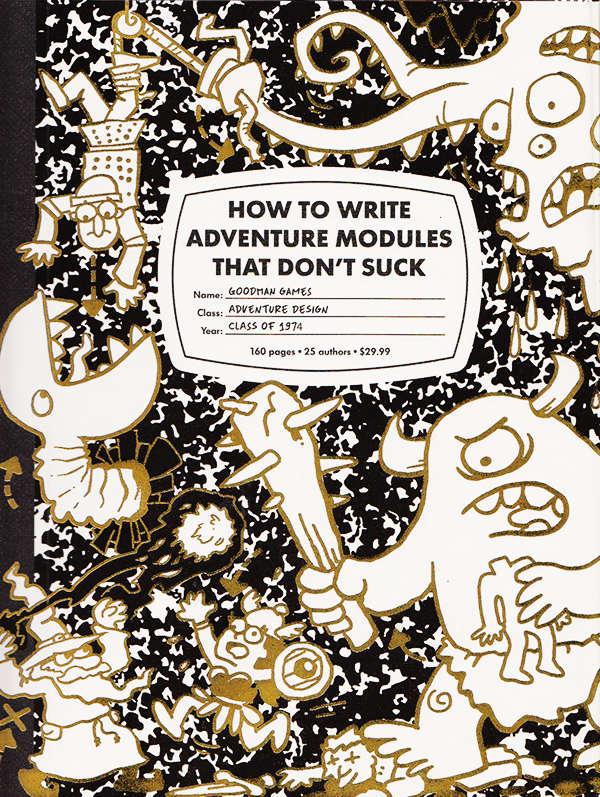
How to Write Adventure Modules that Don't Suck
Goodman Games
A comprehensive anthology featuring essays from experienced game designers. It covers topics like encounter design, player interaction, narrative structure, and sensory immersion. Each essay provides practical advice and example encounters, making it both a practical and inspiring guide for novice and seasoned adventure writers.
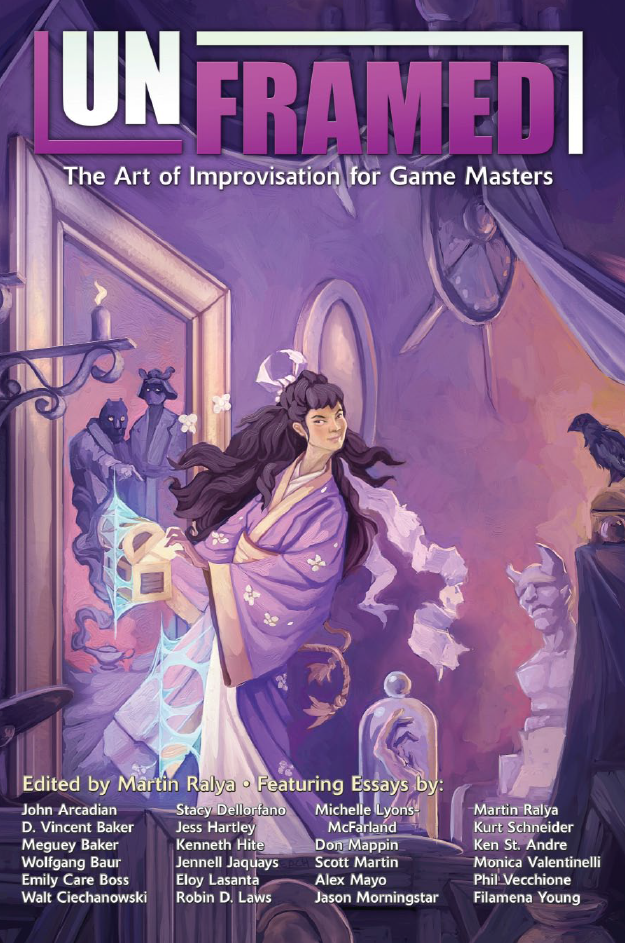
Getting Off the Railroad and Onto the Island
John Arcadian in "Unframed"
In this essay, John Arcadian presents Island Design Theory, a prep strategy for GMs that focuses on modularity and adaptability. Rather than a rigid, linear plot, the game is broken into "islands", separate elements like encounters, clues, and NPCs, that players can explore in any order.
This method allows GMs to adapt to players' actions on the fly while keeping the narrative coherent. It's a thoughtful approach for balancing structure and improvisation in RPGs in the same vein as Jason Alexander's node-based design, and another inspiration in the design of Alkemion Studio.
Anatomy of Adventure
M.T. Black
Anatomy of Adventure is a reflective and practical essay on adventure design, focusing on the value of learning through imitation, creating meaningful player choices, and using constraints to fuel creativity. The author shows how limitations, whether they're resource-based or structural, can lead to creative solutions that make adventures more unique.
The book also explores non-linear dungeon design, interactive elements, and the importance of giving players visible and impactful decisions. This essay is a great read and offers a roadmap for turning limitations into great storytelling tools.
Robin's Laws of Good Game Mastering
Robin D. Laws
The "Campaign Design" and "Adventure Design" sections of Robin's Laws of Good Game Mastering provide essential advice for creating memorable TTRPG experiences. "Campaign Design" contrasts on-the-fly campaigns with carefully planned ones, weighing flexibility against consistency. It stresses aligning themes and genres with player preferences for maximum engagement.
"Adventure Design" focuses on building clear, actionable plot hooks, structured adventures, and making sure player actions drive the story forward.
Sharper Adventures in Heroquest Glorantha
Robin D. Laws
Sharper Adventures in HeroQuest Glorantha is a concise guide written by Robin D. Laws as a fundraiser for the Kraken convention in Germany. It provides a toolkit for crafting memorable adventures. It highlights the importance of defining a core activity, establishing emotional stakes, and structuring narratives with key beats like the Point of No Return and Escalation.
While rooted in HeroQuest, the techniques apply broadly to other systems.

Adventure Crucible
Robin D. Laws
In Adventure Crucible, Robin D. Laws explores the foundations of scenario design for traditional RPGs, breaking down five core structures: Dungeon, Mystery, Chain of Fights, Survival, and Intrigue. Each structure is examined to highlight its strengths, challenges, and best practices for engaging play.
Laws provides practical advice on crafting compelling obstacles, emotional stakes, and satisfying resolutions. This essay serves as both a guide and a diagnostic tool for refining your adventures.
The Complete Kobold Guide to Game Design
Kobold Press
The "Enhancing Adventures" section of this collection brings together leading RPG designers on adventure creation. Ed Greenwood's "Crafting a Dastardly Plot" and Wolfgang Baur's "Challenge and Response" offer frameworks for creating conspiracies and pacing encounters.
The book provides practical techniques for city adventures, mysteries, and monster hordes, with a focus on player agency and meaningful choices. These essays influenced Alkemion Studio's node-based design, particularly the approach of creating connected story elements that support player-driven narratives.
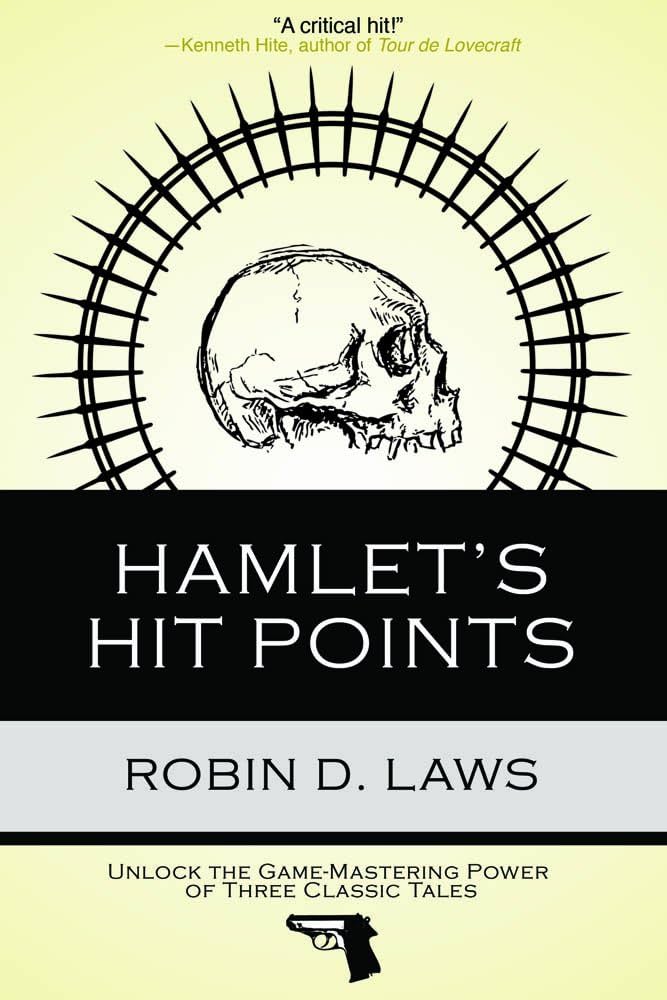
Hamlet's Hit Points
Robin D. Laws
Robin D. Laws develops a system for analyzing stories in ttrpg by breaking them into small moments called "beats". Each beat either makes the audience feel more hope or more fear. He identifies two main types: procedural beats (about external goals and action) and dramatic beats (about emotions and relationships). Laws applies this system to three famous stories: Hamlet, Dr. No, and Casablanca. His detailed breakdowns show that good stories constantly switch between hope and fear, never staying in the same emotional zone for too long.
The book gives practical advice for game masters who want to analyze stories, plan better game sessions, and fix pacing problems during play.